
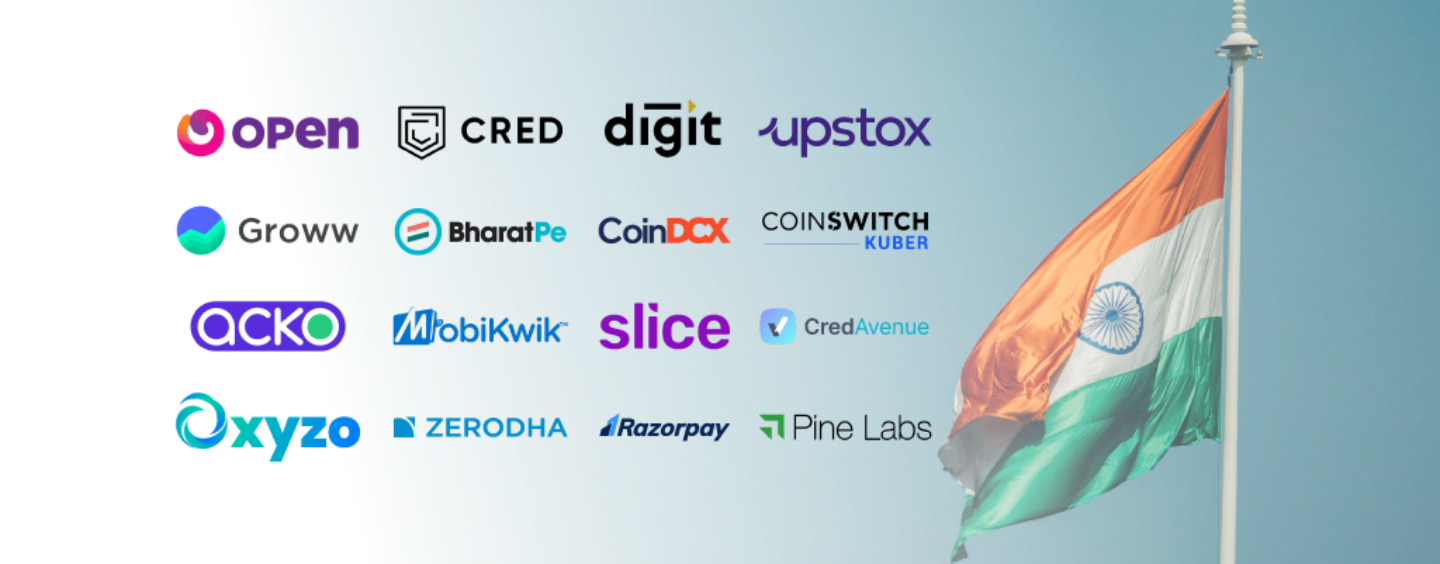
Top 20+ FinTech companies in India (2025)
We all have heard about the excitement around FinTech companies in India. FinTech companies work with financial institutions and consumers to improve current services and develop automated financial solutions. Among other financial services, the services offer wealth management, equity trading, insurance, payment gateways, and alternative credit scoring.
FinTech business growth in India has been unprecedented for the last decade. Between 2010 and 2015, there was a drastic increase in the number of FinTech startups in India, with 1216 new companies entering the market. The Indian FinTech ecosystem reached $31 billion in 2021, ranking as the third-largest FinTech sector globally. FinTech businesses have made it feasible for users to obtain virtual financial services that are simple to use, less expensive, and quicker as we move toward a cashless economy.
There are many reasons that are leading to the growth of FinTech companies in India. Let’s have a look at them.
Reasons for the Growth of FinTech Companies in India.
The growth of FinTech companies in India can be attributed to the three pillars, i.e., The Banks, The Startups, and the Government. Let’s analyze how these three contributed to the growth of the FinTech Companies.
1. Government
Through its numerous legislative efforts, the central government has pushed for a cashless digital economy, which has helped to establish a solid foundation for the FinTech industry. The following is a list of these elements through which the government has given a boost to the FinTechs.
- India Stack – With the advent of India Stack, which is essentially a collection of APIs, enterprises, developers, and startups are now able to utilize a distinctive digital infrastructure. The government has made an effort to provide MNCs, startups, and innovators with a cutting-edge technology framework, which would help the country’s FinTech industry flourish more quickly.
- Startup India Initiatives – The Center’s Startup India initiative includes a number of tax breaks, regulatory relaxation, revisions to the patent system, mentorship, and a major increase in government financing. As a consequence, it helps a variety of FinTech firms flourish and is highly useful to them.
- NPCI (National Payments Council of India Initiatives) – With the launch of the UPI ( Unified Payment Interface), the NPCI has taken advantage of the mobile phone industry’s explosive expansion and the 4G/5G revolution, lowering the infrastructure costs for FinTech businesses. The NPCI has developed a number of ground-breaking projects that provide a strong foundation for the development of a digitally enabled FinTech industry in the nation. Services such as —the Bharat Bill Payments Scheme (BBPS), Aadhar Enabled Payment System (AEPS) and, Digital KYC, BHIM (Bharat Interface for Money)—seek to make it easier for all social classes in India to make digital payments.
2. Startups
India’s FinTech industry received the very-needed attention it deserved in the year 2016 and has been expanding ever since the Demonetization gave the Payments industry a boost. A number of unbanked, newly banked, and underbanked consumers have contributed to alternative lending’s positive growth rate. However, there’s still a lot of scope for development in the FinTech system.
- Payments – By 2020, the country’s digital payments market had reached around $500 billion, or 15% of the Gross Domestic Product (GDP). According to estimates, cash still accounts for 80% of economic transactions in India, compared to 21% in industrialized economies. There’s a lot of opportunity for improvement in this. Transaction volume increased significantly in the years 2016–2017 and has continued to rise since then. Applications for mobile payments, including wallets, P2P transfer services, and mobile points of sale, are as in demand as ever and have a high user adoption rate among the nation’s tech-savvy people.
3. Banking Institutions
Financial institutions have made significant investments in cutting-edge technologies to enhance the client experience and other aspects of their internal operations. Large commercial banks can be observed investing globally in companies using blockchain, machine learning, and artificial intelligence for both front and back offices.
These are some of the reasons that contributed to the growth of FinTech companies in India.
It’s time to learn about some well-known FinTech companies in India now that you have some understanding of the development of FinTech businesses.
Top FinTech Companies in India(2025)
This list will comprise some of the well-known FinTech companies of India and will help you know a little bit more about them.
Paytm
The largest digital wallet provider in India, Paytm, is based in Noida, Uttar Pradesh. Millions of Indian consumers utilize their main product, the PayTM mobile wallet. Paytm employs 16533 workers and generates US$660 million in sales (2022). It was established in 2010. A private firm, Paytm. Paytm was founded by Vijay Shekhar Sharma, who also serves as CEO. Paytm was founded in 2010 and has since acquired 12 businesses and 18 investments, including Nearbuy, Insider.in, and Edukart, raising a total of 2.2 billion USD in 4 fundraising rounds.
Razorpay
A provider of digital payment technology, Razorpay assists companies of all kinds in accepting and controlling client payments. Bengaluru, Karnataka, India, is home to its corporate headquarters. With over 400 employees and $4 million in revenue, Razorpay (2016-17). It was founded in 2014 by ex-IITians Shashank Kumar and Harshil Mathur. Since its inception, Razorpay has raised a total of 106 million USD over 5 investment rounds. Harshil Mathur leads Razorpay as its CEO.
Policybazaar
One of the renowned online life insurance and general insurance aggregators, PolicyBazaar is headquartered in the Indian state of Haryana’s Gurgaon. It was established in 2008 by Alok Bansal, Avanish Nirjar, and Yashish Dahiya. Since its inception, PolicyBazaar has completed 7 financing rounds, raising a total of 346 million USD. Sarbvir Singh was named CEO in February 2020, with effect from December 2019, while Yashish Dahiya assumed the position of group CEO.
Upstox
Financial services offered by Upstox include investments in different mutual funds, stocks, derivatives, exchange-traded funds, commodities, and even digital gold. By providing zero brokerage for equities transactions and INR 20 per order for intraday, currencies, and commodities, it offers complete transparency in pricing. For other young Indians, the founders of Upstox, Kavita Subramanian, Ravi Kumar, and Srini Vishwanath, had the notion to make investing and trading simpler and more affordable. With more than 250 staff and backing from business titans like Ratan Tata and Tiger Global, the Mumbai-based FinTech company aims to make trading easy for its users.
PhonePe
PhonePe is an Indian startup that specializes in financial technology and digital payments, with its headquarters in Bengaluru (Karnataka). In 2015 December, Rahul Chari, Sameer Nigam, and Burzin Engineer established PhonePe. In August 2016, the UPI -(Unified Payments Interface) based PhonePe app went online. Flipkart, a Walmart subsidiary, is the owner of it. There are 11 Indian languages represented in the PhonePe app. Users of PhonePe can receive and send money, reload data, DTH, mobile, and utility cards, pay for goods and services, buy mutual funds, insurance, and even gold and silver, and invest in liquid and tax-saving funds.
PhonePe is accepted as a payment option by over 2.5 crore online and offline merchant outlets spread over 15,700 villages and towns. The app has benefited more than 10 crore users as of June 2018 and processed 500 crore transactions by December 2019. It currently has over 35 crore registered users with over 15 crore monthly active users. PhonePe is licensed by the Reserve Bank of India for the issuance and operation of a Semi Closed Prepaid Payment system.
MobiKwik
Upasana Taku and Bipin Preet Singh started one of the most well-known FinTech companies MobiKwik, in 2009. Its main office is in Gurugram. Online as well as mobile payments, DTH as well as phone recharge, online shopping, and even mobile transfers, and many other services are all provided by MobiKwik, a supplier of digital wallet services. People who use MobiKwik can keep up to INR 50,000 in their MobiKwik wallet, which they can use to purchase anything online, pay their bills, and recharge their mobile phones. Their customers may also buy bus tickets using the cash pick-up option and pay in part for the tickets using the feature of partial payment NET1, GMO Venture Partners, and Sequoia Capital are a few of the investors in MobiKwik.
Pine Labs
To ensure smooth offline businesses and brands, a Gurugram-based FinTech platform Pine Labs was established by Lokvir Kapoor, Rajul Garg, and Tarun Upadhyay created it in 1998. The petroleum industry initially provided a smart card-based payment and loyalty solution. Then it unveiled a PoS device for offline retailers. With the help of its cloud-based “Plutus PoS” solution, merchants can now accept debit and credit cards, e-wallets, QR codes, and UPI-based payments in addition to traditional POS terminals. Marketing tools, reporting and analytics, payment gateway API solutions, mobile payment solutions (through myPlutus), gift card and loyalty programs, value-added solutions like EMIs, discounts, pay-by-point, loyalty solutions, e-wallets, and others are among the products and services offered by Pine Labs.
Khatabook
One of the fastest-growing SaaS companies in the world, Khatabook was established in October 2018 by Dhanesh Kumar, Ashish Sonone, Jaideep Poonia, Vaibhav Kalpe and Ravish Naresh. With more than 50 million downloads in a very short amount of time, it has emerged as India’s top business management app for MSMEs. This smartphone app from Bangalore notifies users via SMS and WhatsApp when money is due for payment or collection. Additionally, 11 languages are supported, making it simple for speakers of many languages to utilize. MSME businesses may track various business transactions securely and safely using Khatabook. At the India Digital Awards in February 2020, it won “Best Innovative MobileApp” for 2020.
ZestMoney
ZestMoney combines mobile technology, online banking, and artificial intelligence to make getting loans easier. ZestMoney does not view the lack of credit history as a roadblock to getting a loan, despite the fact that many financial institutions are reluctant to lend money without one.ZestMoney’s AI-based machine learning decision engine builds a risk profile for each loan. Those who don’t have enough credit history can provide more details, and ZestMoney’s Decision Engine will then assess the borrower’s credibility and decide whether or not to give him money after evaluating his information.
Mintoak
One of India’s top Fintech companies is Mintoak. It’s a white-label merchant payment platform that gives companies the option to accept all cards and cash payments online and generates a single transaction report. Mintoak derives money from membership fees and a portion of the sales of the banks’ products in association with HDFC Bank Ltd. and State Bank of India, where the former owns 5.2% of the company.
KredX
The first marketplace for invoice discounting in India is KredX. Selling their unpaid receivables gives businesses immediate access to operating cash in only 24 to 72 hours while giving investors a chance to make a special short-term investment with low risk and high return. Anurag Jain founded the firm, which offers a technical platform that links institutional and individual investors with high-growth companies searching for operating cash through invoice discounting.
BharatPe
A financial startup called BharatPe serves Indian kirana shop owners and small business owners. The firm provides a variety of fintech solutions, including small business finance, interoperable QR codes for UPI payments, and Bharat Swipe (POS machines) for card acceptance. Additionally, it has said that it intends to help its financial partners arrange a $300 Million loan book via postpe in the first 12 months.
Groww
Former Flipkart employees Lalit Keshre, Harsh Jain, Neeraj Singh, and Ishan Bansal formed the company in 2017. Groww Assist, a service that provides clients with an independent analysis of all mutual funds available on the market, aims to inform investors about the various risks connected to each portfolio. Groww’s SmartSave service is an investment tool that works like a bank account and allows customers to withdraw funds from their investments.
Bill Desk
Online payment service provider Bill Desk is based in Mumbai, Maharashtra, India and its corporate parent is IndiaIdeas. With over 400 workers and $132 million in sales, Bill Desk (2017-18) was established in 2000. Bill Desk was co-founded by Karthik Ganapathy, Ajay Murthy, and M.N. Srinivasu. Since its inception, it has raised a total of 241 million USD in 4 funding rounds. Bill Desk’s CEO is M.N. Srinivasu. In 2017, BillDesk introduced Coinome, the first cryptocurrency exchange in India.
Lendingkart
Former banker Harshvardhan Lunia and former ISRO scientist Mukul Sachan created Lendingkart in 2014 as a digital financing platform for SMEs. Small and medium enterprises can borrow money from Lendingkart for working capital and commercial purposes. The organization is based in Ahmedabad, Gujarat, India. With over 600 workers and $32 million in revenue, Lendingkart was established in 2014. After its inception, it has already completed ten investment rounds, raising a total of 200 million USD.
Acko
Acko is an internet insurance service provider that controls every aspect of business through its online platform. The organization’s main office is in Mumbai, Maharashtra, India. With over 200 people and $1 million in revenue, Acko (2017-18). It was established in 2017. Acko is an independent business. The CEO and Founder of Acko is Varun Dua. Acko has raised 107 million USD in 4 fundraising rounds since its 2017 inception.
Ofbusiness
Small firms can borrow operating money through Ofbusiness. It’s headquartered in the Indian state of Haryana’s Gurgaon. Ofbusiness employs 200+ people and generates $31 Mn in sales (2017-18). It was established in 2015 and is an independent business. Ofbusiness was co-founded by Vasant Sridhar, Asish Mohapatra, Nitin Jain, Bhuvan Gupta, and Ruchi Kalra. Ofbusiness was founded in 2015 and has already raised 49 million USD in 4 investment rounds. The CEO of Ofbusiness is Mr. Asish Mohapatra.
Easiloan
Easiloan, the first Fintech company for home loans in India, uses its in-house AI engine to manage home loans digitally. The digital platform of Easiloan was developed for house purchasers (looking for a home loan) and real estate developers. Its unique partnerships with top financial institutions and banks, including ICICI Bank, HDFC, SBI, PNB, Bajaj Housing Finance, IIFL House Finance, and others, broaden the home buyer’s access to loan alternatives. It’s headquartered in Mumbai, and has seen hyper-growth in its first seven months of operation. The business has so far handled hundreds of home loan cases using its unique technology after receiving INR 8 crore in early investment from Tomorrow Capital.
InstaMojo
Businesses can use Instamojo’s online payment gateway service. Bengaluru, Karnataka, India, is home to its corporate headquarters. With over 100 people and $1 million in revenue, Instamojo was established in 2012. Instamojo was co-founded by Akash Gehani, Harshad Sharma, Sampad Swain, and Aditya Sengupta. Instamojo, which debuted in 2012, has raised a total of 10 million USD over 5 fundraising rounds. Sampad Swain serves as Instamojo’s CEO.
Payswiff
For SMEs and Enterprises, Payswiff offers omnichannel electronic payment solutions. The organization’s main office is in Hyderabad, Telangana, India. Payswiff employs 200+ workers and generates $14 Mn in sales (2017-18). It was established in 2013 and is an independent business. Payswiff was co-founded by Ravi Kiran, Priti Shah, Anil Bharadwaj, Maulik, and Krishna Kishore. It was launched in 2013 and has already raised a total of 2.5 million USD through 1 investment round. Priti Shah is Payswiff’s CEO.
According to analysts, FinTech businesses in India will expand exponentially in the next few years. The only way to achieve such growth is to make technology more accessible. As people acquire new financial instruments in a changing economic environment, new innovations will emerge.
It is through these sorts of growth that India is likely to attain financial maturity and economic growth.